Castle Rock Public Works Department
Needful ThingsThe Castle Rock Public Works Department is the town’s largest and most expensive municipal operation, run by Deke Bradford. Its role in the story shifts from routine public service to an inadvertent point of exposure: a delivery of explosives reveals that Danforth “Buster” Keeton has enlarged the department’s order, linking a public-works purchase to the danger gathering around Castle Rock.
Department and Leadership
Castle Rock Public Works Department is identified as Castle Rock’s biggest and most expensive operation. Deke Bradford runs it, and Alan Pangborn encounters him outside the Town Garage while trying to locate Hugh Priest. Bradford tells Alan that Hugh has not been at work that day and asks him to pass along that Hugh is fired if Alan sees him first.
Bradford’s decision to keep Hugh employed was not simply an administrative oversight. He acknowledges that he kept him longer than he should have because he believed there was a good man beneath Hugh’s drinking. When sober or not suffering from a hangover, Hugh could work harder than anyone in town, and Bradford hoped the steadiness of a job might help him change. The exchange presents the department as a workplace whose practical responsibilities coexist with Bradford’s personal judgment of the people he employs.
The Town Garage and Explosives
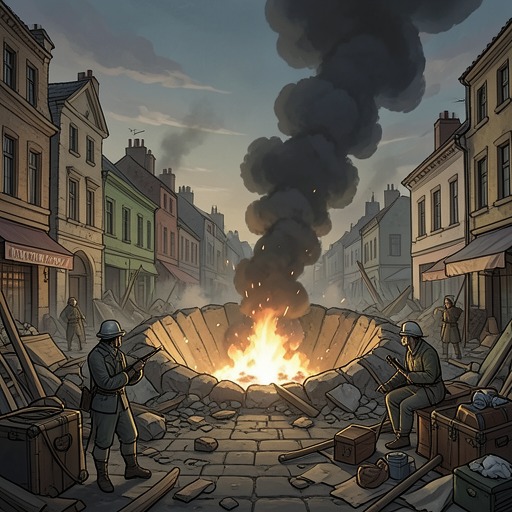
The department’s Town Garage is the setting for a delivery that gives Alan a concrete reason to question the town’s supply of explosives. Outside the garage, a Case Construction and Supply truck is being unloaded; its small, heavy wooden crates bear the red diamond used to mark high explosives. Bradford calls out to the workers to handle the crates carefully, making the unloading itself part of the scene rather than background activity.
Bradford explains that the department has ordered twenty cases for a planned blast at a gravel pit on Route 5, where workers will remove a granite outcrop. The amount appears excessive to Alan, particularly because Bradford says there will be enough remaining to use on Hugh if he wishes. The explosives are kept cool in an air-conditioned shed because, Bradford explains, they can sweat; he follows a better-safe-than-sorry approach despite what others say about the newer material.
Buster Keeton’s Expanded Order
The purchase was not Bradford’s idea alone. He tells Alan that Buster added to the order, without Bradford knowing why. This is the critical irregularity: a municipal explosives purchase intended for roadwork and quarry blasting has been enlarged by a town official whose addition has no stated public-works rationale.
Alan immediately registers the implication, repeating that Buster topped the order. The department’s ordinary procurement process thus becomes a clue to a threat beyond its stated project. Its staff are handling explosives for legitimate municipal work, but the extra quantity makes the Town Garage a point where the town’s public infrastructure intersects with the larger plan against Castle Rock.
Narrative Significance
The department’s significance lies in this contrast between routine civic function and the dangerous use to which its resources may be put. Its planned granite-pit blast explains why explosives are present; Buster’s unexplained addition makes the shipment alarming. Bradford’s candor supplies the fact Alan needs, while the crates and the temperature-controlled shed establish the scale and practical handling of the stockpile without making the department itself responsible for the added order.
Public Works therefore serves as an institutional setting where the crisis becomes visible through ordinary details: a purchase order, a delivery truck, workers unloading marked cases, and a manager explaining why the material must be kept cool. What begins as a question about Hugh’s absence ends with Alan recognizing that the town has far more explosive material than the department’s stated job requires.